
Essay on Dowry System in 100, 150, 200, 250, 300 and 500 Words

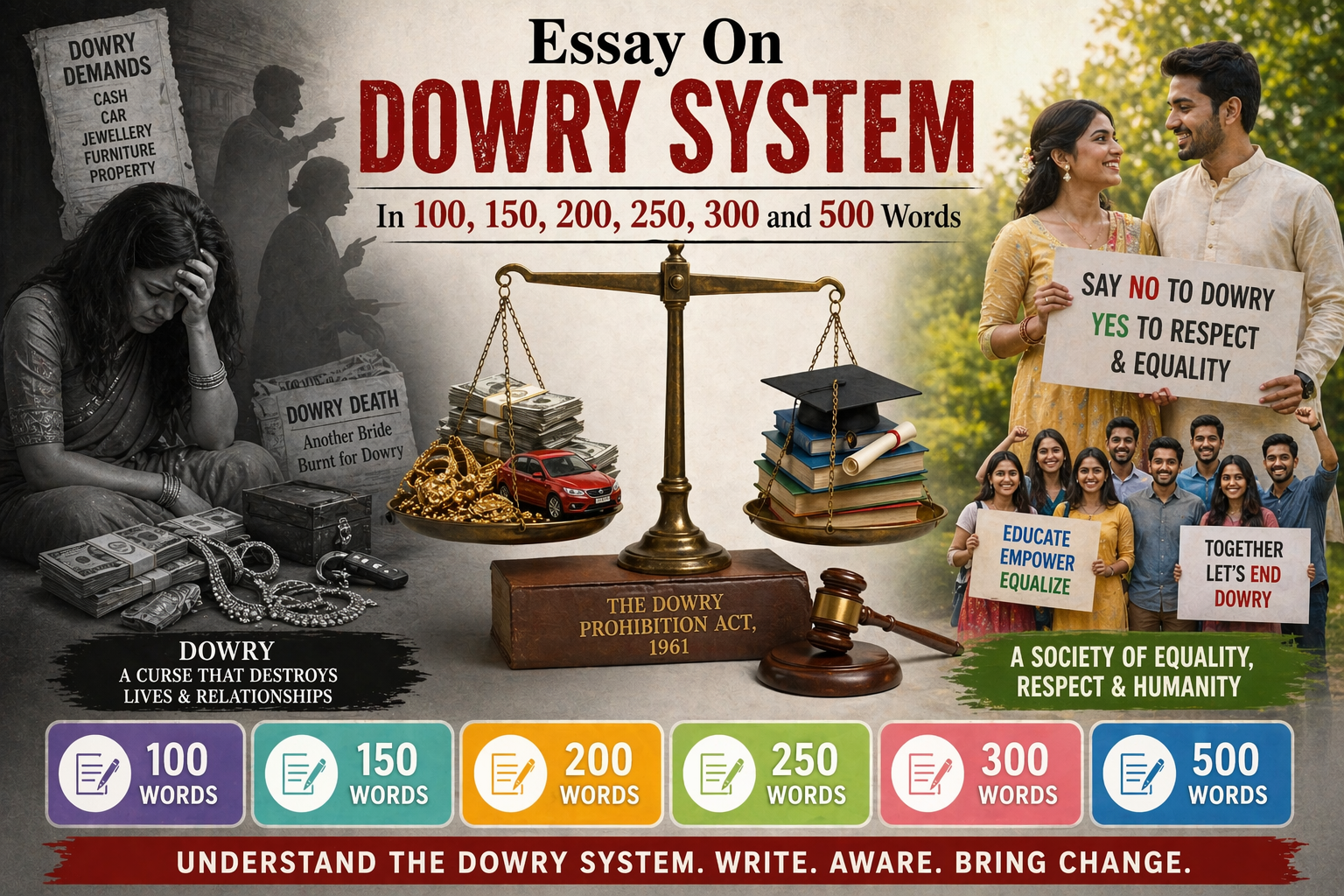
The dowry system in India (known as Dahej (दहेज) in Hindi) refers to the transfer of cash, property, durable goods, jewellery, or real estate from the bride’s family to the groom’s family as a condition of marriage. Semantically, the concept of dowry intersects with inheritance structures, gender economics, patriarchal social norms, and transactional views of marriage.
Understanding the dowry system essay requires more than surface-level condemnation. It demands an investigation into why the practice began, how it evolved, what laws exist to stop it, and where it continues to cause the most harm in 2024 and 2025.
Whether you are a student searching for an essay on dowry in 100 words, a researcher analysing India’s social policy failures, or a parent trying to understand your legal rights, this comprehensive resource covers every angle — from short essays to deep analytical writing.
Internal Resource: Before reading further, you may find it helpful to understand Is Dowry Illegal in India? and the Possible Legal Implications of Dowry on our blog.
Dowry System Essay: 100 Words
The Dowry System: A Social Evil That Must End
The dowry system is one of India’s most harmful social practices. It demands that a bride’s family transfer money, property, or goods to the groom’s family at the time of marriage. Though the Dowry Prohibition Act of 1961 makes this practice illegal, it continues across communities, castes, and economic classes. Millions of families fall into debt to meet dowry demands. Many women face domestic violence, mental torture, and even death when expectations go unmet. The National Crime Records Bureau (NCRB) recorded over 6,100 dowry deaths in 2023 alone. Education, awareness, and strict legal enforcement are the only solutions.
Dowry System Essay: 150 Words
Dowry System in India: A Legacy of Inequality
The dowry system, or Dahej Pratha, is a deeply rooted social custom in India where a bride’s family provides the groom’s family with cash, jewellery, property, or other valuables as a precondition of marriage. Originating from ancient customs like Kanyadan (the gift of a daughter) and Stridhan (a woman’s wealth for her security), what was once voluntary has become compulsory and coercive.
Despite being criminalised under the Dowry Prohibition Act of 1961, the practice persists — and in many regions, it has intensified. Research shows that dowry was present in only 35–40% of marriages before 1940, but by 1975 it featured in nearly 90% of all Indian marriages. Today, the NCRB’s Crime in India 2023 report reveals that 15,489 cases were registered under the Dowry Prohibition Act, with 6,156 women losing their lives to dowry-related violence.
This is not tradition. This is a crime.
Dowry System Essay: 200 Words
Dowry System in India: History, Harm, and the Need for Change
The dowry system is among the most persistent social evils embedded in Indian society. Defined as the transfer of material wealth from a bride’s family to a groom’s family at the time of marriage, it has roots in ancient Hindu customs — particularly Kanyadan and Stridhan — that were never intended to become transactional demands.
Historically, scholars like Michael Witzel argue that dowry was not a significant practice during the Vedic period. Documentary evidence further suggests that at the start of the 20th century, bridewealth (paid by the groom’s side) was more common than dowry. The rapid spread of dowry between 1940 and 1975 was largely driven by economic modernisation and increased social stratification, which made groom quality more differentiated across communities.
Today, the social consequences are devastating. According to NCRB 2023 data, over 6,100 women died in dowry-related incidents — meaning nearly 17 women die every single day in India due to dowry. Uttar Pradesh, Bihar, and Madhya Pradesh account for the majority of cases.
Legal remedies include the Dowry Prohibition Act 1961, Section 498A of the IPC (now BNS Section 85–86), and the Protection of Women from Domestic Violence Act, 2005. Yet conviction rates remain abysmally low, suggesting that law alone cannot solve a problem rooted in culture and economics.
True change requires gender-equal inheritance, women’s financial empowerment, and community-level education.
Dowry System Essay: 250 Words
Dowry System in India: Causes, Consequences, and Collective Responsibility
The dowry system in India, known colloquially as Dahej, is a socio-economic transaction where a bride’s family is expected to transfer wealth — in the form of cash, gold, land, vehicles, electronics, or property — to the groom’s family upon marriage. This practice, though illegal since 1961, remains one of the most widespread and damaging social customs in contemporary India.
Historical Origins
The roots of the dowry system lie in ancient Hindu legal customs. The Kanyadan ritual — the “gift of a virgin daughter” — was meant to be an act of generous, voluntary giving. Stridhan, meaning a woman’s personal wealth, was intended to provide a bride with financial independence. Over centuries, however, these voluntary customs morphed into mandatory obligations, commodifying women and transforming marriage into commerce.
The Scale of the Problem
The statistics reveal a grim reality. Research spanning over 74,000 rural Indian marriages across a century found that dowry prevalence doubled between 1930 and 1975, with average payment values tripling. According to the NCRB’s Crime in India 2023 report, 15,489 dowry-related cases were filed — a 14% rise from 2022. Over 6,100 women died. Uttar Pradesh alone recorded 2,122 dowry deaths.
Legal Framework
India has enacted several laws: the Dowry Prohibition Act 1961, Section 498A of the IPC (cruelty by husband/relatives), Section 304B (dowry death), and the Domestic Violence Act 2005. Despite 27,154 arrests under the DPA in 2023, 83,327 cases remained under trial — exposing severe judicial backlog.
Why It Persists
Three forces sustain the dowry system: patriarchal inheritance norms (daughters historically excluded from ancestral property), hypergamy (marrying into a higher social class), and social prestige economics where a daughter’s “worth” is equated with the size of her dowry.
Solutions
Education of women, equitable inheritance enforcement under the Hindu Succession (Amendment) Act 2005, women’s economic empowerment, and stricter implementation of existing laws remain the most effective levers for change.
Internal Link: Understand How to Prove Dowry Harassment if you or someone you know is a victim.
Dowry System Essay: 300 Words
Dowry System in India: A Structural Analysis of a Persistent Social Evil
The dowry system, or Dahej Pratha, is a form of pre-mortem inheritance practised across India in which the bride’s family transfers wealth to the groom’s family at the time of marriage. While legislatively prohibited since 1961, the practice has not only survived — in certain regions, it has intensified, evolved, and adopted disguised forms such as “gifting” and lavish wedding expenditures.
A Century of Data
A landmark study of over 74,000 rural marriages across India across a century reveals the trajectory of the dowry system with disturbing clarity. Before 1940, dowry was present in only 35–40% of marriages. By 1975, that figure had reached nearly 90%. The primary driver of this expansion was economic modernisation, which increased differentiation in groom quality — education, employment, and social capital — making a “better” groom a commodity that families could purchase through larger dowries.
Since 1975, median dowry values have plateaued for lower-income households, while upper-income households have seen decreasing real dowry values. This indicates that the dowry system’s harshest burden falls disproportionately on economically vulnerable families.
The Human Cost
NCRB’s Crime in India 2023 report recorded 6,156 dowry deaths and 15,489 cases filed under the Dowry Prohibition Act — a 14% increase year-on-year. Between 2017 and 2022, India averaged nearly 20 dowry deaths per day. Three in five married women who file domestic violence complaints also report dowry harassment, according to a 2023 study published in the journal Violence Against Women. Experts warn that actual numbers are far higher, as many dowry deaths are misclassified as suicides or accidents.
States like Uttar Pradesh (2,122 deaths), Bihar (1,143 deaths), and Madhya Pradesh (518 deaths) consistently account for the highest burden. Thirteen states, including West Bengal, reported zero DPA cases in 2023 — raising red flags about systemic underreporting rather than genuine absence of the problem.
Regional Patterns
The structure of marriage kinship significantly affects dowry prevalence. In North India, patrilocal marriage systems (where brides move in with the groom’s family) correlate with higher dowry demands. In South India, where marriage within extended families is more common and women have greater land inheritance rights, dowry practices are comparatively less extreme — though far from absent.
The Legal Architecture
India’s legal response to dowry spans several statutes:
- Dowry Prohibition Act, 1961 — criminalises giving, taking, or demanding dowry
- Section 498A, IPC (now BNS Sections 85–86) — punishes cruelty by husband/relatives linked to dowry demands
- Section 304B, IPC (now BNS Section 80) — defines and penalises dowry death
- Protection of Women from Domestic Violence Act, 2005 — provides civil remedies and protection orders
Penalties include up to five years’ imprisonment under the DPA, and seven years to life under Section 304B. Yet in 2012, only 15% of accused under Section 498A were convicted — illustrating a profound gap between legal text and ground reality.
Why Laws Fail
Four structural barriers undermine enforcement: (1) social stigma and family pressure prevent reporting; (2) police routinely misclassify dowry deaths as suicides; (3) the judicial system carries an enormous backlog — 83,327 DPA cases under trial in 2023 alone; and (4) the educated middle class perpetuates dowry through “voluntary” gift-giving that mirrors the same patriarchal logic.
The Path Forward
Eradicating the dowry system requires simultaneous action on multiple fronts: enforcing women’s inheritance rights under the 2005 Hindu Succession Amendment, creating dedicated dowry crime cells within police departments, mandatory law enforcement training, financial literacy programmes for women, and — most critically — a cultural narrative shift that measures women’s value by their personhood, not their price tag.
Related Reading: Dowry Good or Bad? Pros, Cons & Legal Facts and Is Dowry Legal for Muslims?
Dowry System Essay: 500 Words
Dowry System in India: Root Causes, Statistical Reality, Legal Failures, and the Road to Eradication
Introduction: What the Dowry System Really Is
The dowry system in India — locally referred to as Dahej — is not merely an antiquated custom. It is a living, adaptive economic institution that extracts wealth from the bride’s family and transfers it to the groom’s household as a condition of marriage. This transfer may involve cash, gold jewellery, real estate, vehicles, household appliances, or a combination thereof. In value terms, a single dowry transaction typically exceeds a year’s worth of household income — and for millions of families, it is the most consequential financial event of their lives.
The dowry system sits at the intersection of gender discrimination, economic inequality, and patriarchal inheritance norms. To write about it meaningfully is to write about what India values — and what it does not yet protect.
Historical Origins: From Voluntary Gift to Compulsory Demand
Ancient Hindu texts do not present a unified view of dowry. The Kanyadan ritual — the ceremonial giving away of a daughter — was an act of spiritual merit, not a cash transaction. Stridhan (a woman’s personal property) was intended to ensure a bride’s economic independence, not to enrich her in-laws. Ancient eyewitness accounts, including those recorded by Arrian during Alexander the Great’s Indian campaign (c. 300 BC), suggest that dowry was either absent or negligible in that era.
The real escalation of the dowry system is a modern phenomenon. Research on over 74,000 rural marriages across India over the past century shows that dowry was present in only 35–40% of marriages before 1940. The rapid industrialisation and modernisation of India’s economy between 1940 and 1975 created new educational and occupational hierarchies among men. The result: a more differentiated “groom market,” where a better-educated, better-employed groom commanded a higher “price.” By 1975, dowry was paid in nearly 90% of all Indian marriages, with average real values tripling. Between 1950 and 1999, the estimated total value of dowry payments across India approached a quarter of a trillion dollars.
The Human Toll: What the Numbers Say
The NCRB’s Crime in India 2023 report — India’s most authoritative crime database — documents an alarming reality:
- 15,489 cases were filed under the Dowry Prohibition Act in 2023, a 14% rise from the 13,479 cases in 2022
- 6,156 women died in dowry-related incidents in 2023; in 2022, the figure was 6,450
- 833 additional murders cited dowry as the motive
- 27,154 individuals were arrested under the DPA in 2023; 83,327 cases remained under trial
- Between 2017 and 2022, India averaged close to 20 dowry deaths per day
Uttar Pradesh is the most affected state, recording 2,122 dowry deaths and 7,151 DPA filings in 2023. Bihar recorded 1,143 deaths and 3,665 cases. Madhya Pradesh — the home state for many reading this — recorded 518 deaths. This is not a distant problem. It is local, immediate, and deeply embedded.
Critically, experts and investigative journalists argue that even these numbers understate reality. Dowry deaths are routinely misclassified as accidental deaths, kitchen fires, or suicides. Police often delay investigations or pressure families to settle. The “principal offence rule” used by NCRB means that when a single FIR involves multiple crimes, only the most serious charge is recorded — causing dowry-related offences to be statistically absorbed into broader murder or suicide categories.
Why It Persists: The Structural Roots
The dowry system survives not because Indians are uniformly complicit, but because it is structurally reinforced by at least four interconnected systems:
1. Patrilineal Inheritance Norms Historically, daughters were excluded from ancestral property rights. The Hindu Succession Act of 1956 gave women inheritance rights, but only the 2005 amendment made daughters coparceners in ancestral property — and even today, social enforcement lags dramatically behind legal rights. In practice, a daughter’s share is informally “given” as dowry at marriage, converting a legal right into a transactional gift.
2. Hypergamy and Social Mobility In communities where women are expected to marry “up” (a practice called hypergamy), the groom’s family has implicit pricing power. Families use dowry as a “status equaliser,” believing that a higher dowry secures a higher-caste or higher-income match, thereby elevating their daughter’s social standing.
3. The Patrilocal North-South Divide In North India, where brides typically relocate permanently to their husband’s joint family (patrilocality), the bride’s family has less ongoing contact and influence — making the dowry a one-time, lump-sum payment. In South India, where marriage within extended kin networks is more common, women retain closer ties to natal families and often have greater land inheritance rights, creating a structurally different environment in which overt dowry is comparatively less extreme.
4. Middle-Class “Gifting” Culture The educated urban middle class frequently evades the legal and moral weight of the word “dowry” by reframing demands as voluntary “gifts.” A car, a flat, or an international holiday provided at marriage is euphemised — but it represents the same patriarchal transaction with a more photogenic surface.
The Legal Framework: What Exists and Why It Falls Short
India has built a layered legislative response to the dowry system:
| Law | Key Provision |
|---|---|
| Dowry Prohibition Act, 1961 | Criminalises giving, taking, or demanding dowry; up to 5 years’ imprisonment |
| Section 498A, IPC / BNS Sec. 85–86 | Punishes cruelty and harassment by husband or in-laws related to dowry |
| Section 304B, IPC / BNS Sec. 80 | Defines dowry death; mandates 7 years to life imprisonment |
| Protection of Women from Domestic Violence Act, 2005 | Provides civil protection orders, residence rights, and monetary relief |
Despite this framework, enforcement is catastrophically weak. In 2012, only 15% of accused under Section 498A were convicted. In 2022, 359 dowry deaths were closed due to “insufficient evidence” despite complaints being deemed genuine. In 2023, 83,327 cases were pending trial — a judicial backlog that stretches years into the future, during which victims remain in danger.
The gap between law and lived reality is not a gap in legislation. It is a gap in political will, police training, social stigma reduction, and judicial capacity.
Solutions: A Holistic Approach
No single intervention can dismantle the dowry system. What is required is a convergence of policy, economics, culture, and community action:
Legal Enforcement: Dedicated Dowry Crime Cells within state police, mandatory sensitivity training for officers, and fast-track courts for dowry cases with strict timeline mandates.
Economic Empowerment of Women: Aggressive implementation of the 2005 Hindu Succession Amendment, ensuring daughters actually receive and retain ancestral property. Women with independent economic resources are statistically less vulnerable to dowry abuse.
Education and Awareness: School curricula must include gender equality and legal rights. Targeted campaigns in high-incidence states like UP, Bihar, and MP must reach rural communities in their local language and cultural context.
Community Accountability: Religious institutions, panchayats, and community leaders must publicly refuse to endorse or participate in dowry transactions. Social ostracism of families that demand dowry — rather than of those who refuse — would create powerful corrective incentives.
Media and Cultural Narratives: Hindi cinema and regional media have historically both romanticised and mocked dowry. A cultural shift in storytelling — depicting equitable marriages, financially independent women, and families that refuse demands — can reshape norms over a generation.
Conclusion: This Is a Solvable Problem
The dowry system is not inevitable. It is not ancient. It is not sacred. It is a modern institution with traceable historical roots, measurable economic costs, and preventable human consequences. In 2023, over 6,100 Indian women died because of it. Every one of those deaths represents a failure — of family, of community, of state, and of collective will.
The laws exist. The data exists. The solutions are known. What remains is the urgency to act — and the courage to value a daughter more than her dowry.
Explore More on Our Blog:
Key Facts & Statistics at a Glance
| Data Point | Figure | Source |
|---|---|---|
| Dowry death cases in 2023 | 6,156 | NCRB, Crime in India 2023 |
| DPA cases filed in 2023 | 15,489 | NCRB, Crime in India 2023 |
| Year-on-year rise in DPA cases | +14% | NCRB 2023 vs 2022 |
| Daily dowry deaths (2017–2022 avg) | ~20 women/day | The Week, NCRB |
| Cases under trial in 2023 | 83,327 | NCRB |
| Share of marriages with dowry by 1975 | ~90% | ScienceDirect, 2023 study |
| India’s estimated dowry payments 1950–1999 | ~$250 billion | Academic Research |
| UP dowry deaths in 2023 | 2,122 | NCRB |
| Domestic violence complaints with dowry harassment | 3 in 5 | Violence Against Women, 2023 |
Frequently Asked Questions (FAQ)
Q1: What is the dowry system in simple words? The dowry system is a practice where a bride’s family gives cash, property, or goods to the groom’s family as a condition of marriage. Despite being illegal in India since 1961, it continues widely across communities.
Q2: Is dowry legal in India? No. Dowry is illegal under the Dowry Prohibition Act, 1961. Giving, taking, or demanding dowry can result in up to 5 years in prison and a fine. Read the full legal guide here.
Q3: How many dowry deaths happen in India every year? According to NCRB’s latest data, 6,156 women died in dowry-related incidents in 2023, and 6,450 in 2022 — roughly one death every 90 minutes.
Q4: Which state has the most dowry deaths in India? Uttar Pradesh consistently reports the highest number — 2,122 deaths in 2023. Bihar and Madhya Pradesh follow with 1,143 and 518 deaths respectively.
Q5: What is the difference between dowry and Mahr? Dowry flows from the bride’s family to the groom’s family. Mahr (practiced in Muslim marriages) is a mandatory gift from the groom to the bride — the opposite direction and intention. Learn more about dowry and Muslims here.
Q6: What causes the dowry system in India? Key causes include patriarchal inheritance norms, hypergamy (social climbing through marriage), patrilocal family structures, women’s economic dependence, and social prestige dynamics.
Q7: How can the dowry system be abolished? Through a combination of enforcing women’s inheritance rights, creating dedicated police units for dowry crimes, fast-track courts, community education, and a sustained cultural shift away from transactional views of marriage.
This article was researched and written based on data from the National Crime Records Bureau (NCRB), peer-reviewed academic studies, and legal documents related to the Dowry Prohibition Act of India. All statistics cited reflect official government data as of 2023.
