
Dowry Meaning: Hindi, Bengali, Telugu, Malayalam, English, Gujarati, panjabi, Marathi & Tamil

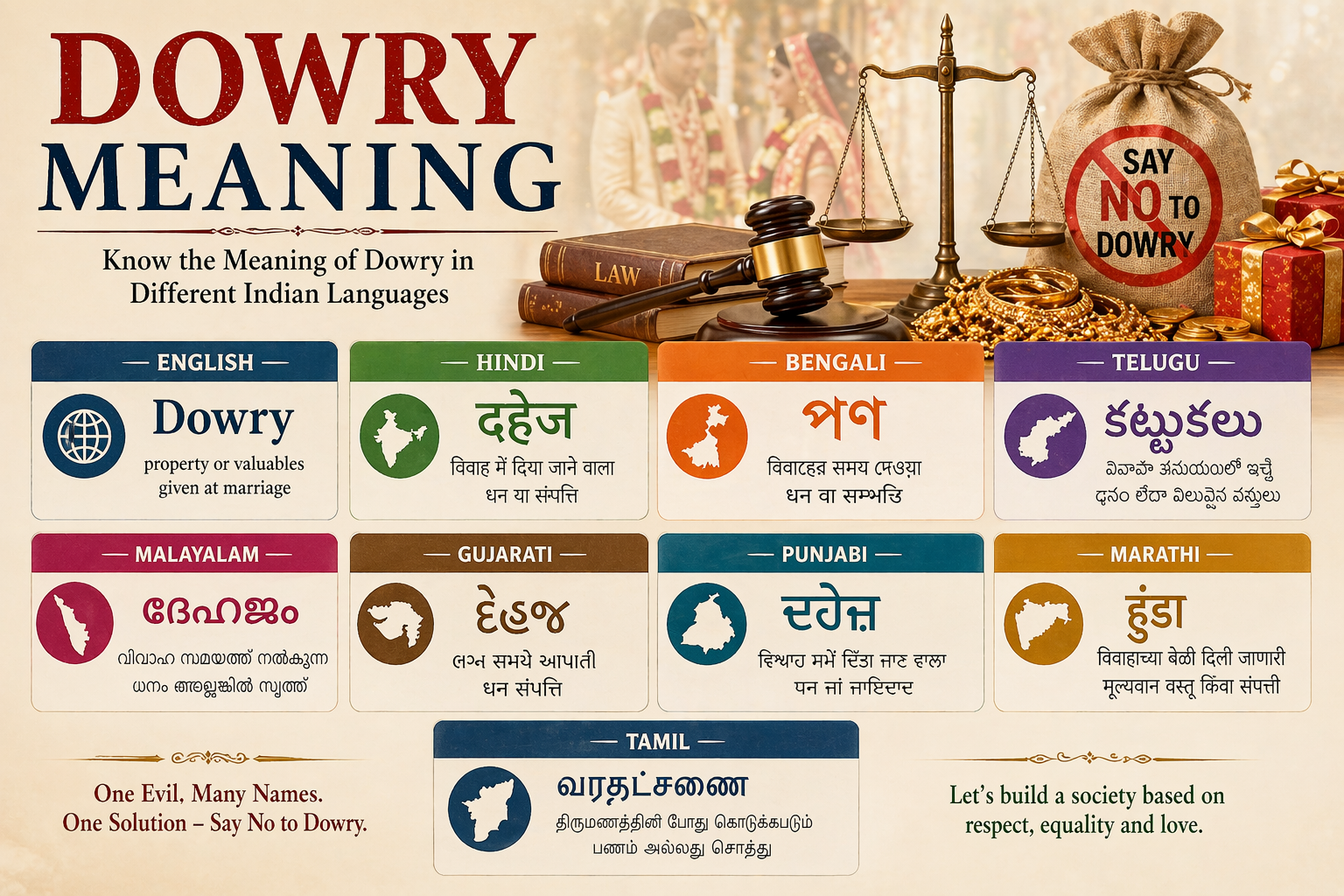
Know the exact meaning of dowry in Hindi (दहेज), Bengali (যৌতুক), Telugu (కట్నం), Malayalam (സ്ത്രീധനം), Gujarati, Punjabi, Marathi, Tamil & English. Cultural semantics, legal context & regional differences explained.
Before you understand how each Indian language names this practice, you must understand what the concept semantically encodes. Dowry is a property transfer — money, land, jewelry, livestock, or commercial assets — made by the bride’s family to the groom or his family at the time of marriage. The semantic entity is not a “gift” in the neutral sense; it is a structured economic transaction embedded in matrimonial systems.
The word derives from Old French douaire (meaning “dower”), itself from Latin dotarium, referring to a conjugal gift. Globally, dowry is called jahez in Urdu, joutuk in Bengali, varadhachanai in Tamil, khatnam in Telugu, and streedhanam in Malayalam.
In India, the Dowry Prohibition Act of 1961 made this practice illegal. Yet its semantic presence across nine major Indian languages reveals how deeply the concept is encoded into matrimonial culture. To understand the full legal picture, read What Are The Possible Legal Implications of Dowry in India?
1. Dowry Meaning in English
Core Term: Dowry | Phonetic: /ˈdaʊri/ | Part of Speech: Noun (plural: dowries)
In English, dowry is defined with precise semantic boundaries: it refers to money that a woman’s family gives to the man she is marrying in some cultures. This is the Cambridge Learner’s Dictionary definition — intentionally narrow, intentionally neutral. But the English semantic field of “dowry” has always carried ambivalence.
The entity-level distinction in English is important. Dowry is distinguished from bride price (payment by the groom’s family to the bride’s family) and dower (property settled on the bride by the groom). While bride price is a payment by the groom or his family to the bride or her family, dowry is the wealth transferred from the bride or her family to the groom or his family.
In contemporary English discourse — particularly in Indian-English — “dowry” carries immediate negative semantic weight: harassment, violence, coercion. Understanding whether dowry is considered good or bad from a legal and ethical standpoint is explored further in Dowry Good or Bad? Pros, Cons & Legal Facts.
2. Dowry Meaning in Hindi (दहेज — Dahej)
Term in Hindi: दहेज (Dahej) | Script: Devanagari | Pronunciation: /dɑːheɪdʒ/
Synonyms in Hindi: यौतक (Yautak), वर-दक्षिणा (Var-Dakshina), हुँडा (Hunda)
Hindi carries the most institutionally documented term for dowry in India. दहेज का अर्थ है जो सम्पत्ति, विवाह के समय वधू के परिवार की तरफ़ से वर को दी जाती है — the property given by the bride’s family to the groom at the time of marriage. In Hindi, “Dahej” has become a legally loaded term. Section 498A IPC and the Dowry Prohibition Act 1961 use “दहेज” as the operative word in their legal definitions.
Semantically, Hindi distinguishes between दहेज (demanded transaction) and उपहार (voluntary gift) — a distinction that courts rely on when adjudicating cases. The term also carries secondary associations: dahej pratha (दहेज प्रथा) means the dowry system, and dahej hatyaa (दहेज हत्या) means dowry murder. To understand how this law operates in practice, see भारत में दहेज प्रतिषेध अधिनियम 1961 – धाराएं, सज़ा और बचाव.
3. Dowry Meaning in Bengali (যৌতুক — Joutuk)
Term in Bengali: যৌতুক (Joutuk) | Script: Bengali script | Pronunciation: /dʒoʊtʊk/
Alternative terms: পণ (Pon — more associated with bride price in some contexts)
Dowry in Bengali is called joutuk, a term with a semantic history that stretches back centuries in Bengal’s matrimonial culture. The word joutuk carries a slightly more neutral tone etymologically — it does not inherently encode coercion — but in lived Bengali usage, it has become synonymous with familial financial pressure.
In Bangladesh and West Bengal, the semantic weight of joutuk is particularly intense in rural communities where the practice persists despite legal prohibition. The Bengali cultural imagination often frames joutuk in narratives of middle-class aspiration and family honor (maryada), where the “quality” of a groom’s dowry demand signals his perceived social worth. This intersection of economics and social status is what makes the term semantically complex in Bengali — it simultaneously encodes shame, expectation, burden, and tradition. The social dynamics behind dowry deaths in India are examined in Dowry Deaths in India: Cases Rising or Falling?
4. Dowry Meaning in Telugu (కట్నం / కానుక — Katnam / Kanuka)
Primary Term: కట్నం (Katnam) | Wikipedia-cited Term: khatnam | Script: Telugu script
Additional term: వరకట్నం (Varakatnam) — literally “groom’s dowry”
In Telugu, the term varakatnam (వరకట్నం) is the most semantically precise compound noun for the dowry system. Breaking it down: vara (వర) = groom/boon, katnam (కట్నం) = dues/amount owed. This compound encodes directionality — it is explicitly the amount owed to the groom’s side.
In Telugu, dowry is explored with cultural nuances that reveal both direct translations and contextual expressions used in daily life, reflecting how the practice is woven into matrimonial negotiations across Andhra Pradesh and Telangana. In Telangana particularly, dowry demand (కట్నం అడగడం) is a phrase in everyday vocabulary. Semantically, Telugu also uses kanuka (కానుక — gift) as a euphemism, allowing families to reframe coerced transfers as voluntary offerings — a linguistic camouflage that complicates legal enforcement.
5. Dowry Meaning in Malayalam (സ്ത്രീധനം — Streedhanam)
Primary Term: സ്ത്രീധനം (Streedhanam) | Script: Malayalam script | Pronunciation: /striːd̪ʱənəm/
Malayalam encodes the most etymologically revealing term of all nine languages. Streedhanam breaks into: stree (സ്ത്രീ) = woman, dhanam (ധനം) = wealth/property. Literally: “woman’s wealth.” This etymology suggests an ancient origin where the transferred property was conceptually the bride’s own wealth — her inheritance carried into the marriage.
In Malayalam, dowry refers to the material assets received by the groom from the bride’s guardians or parents at the time of marriage — known as സ്ത്രീധനം. The semantic shift from “woman’s own wealth” to “wealth surrendered to the groom’s family” tracks the historical distortion of the practice. In Kerala’s Christian and Hindu communities, streedhanam often takes the form of gold jewelry and property. Kerala’s high literacy rate has not eliminated the practice — rather, it has formalized it into more contractual arrangements, with the term carrying legal-transactional meaning in modern matrimonial discourse. For a deeper look at how dowry functions in Muslim marriages specifically, see Is Dowry Legal for Muslims? Mahr Explained.
6. Dowry Meaning in Gujarati (દહેજ — Dahej)
Term in Gujarati: દહેજ (Dahej) | Script: Gujarati script | Pronunciation: /dɑːheɪdʒ/
Gujarati shares the term Dahej with Hindi, given the shared Indo-Aryan linguistic roots, but the cultural semantics in Gujarat differ meaningfully. In Gujarati matrimonial culture, dowry is often articulated through the broader framework of lagna prakarno (wedding ceremony expenses), where dowry demands are embedded within the ceremonial gifting system.
In Gujarati, dowry is referred to as dahej, and its practice involves substantial financial and material transfers at the time of marriage, including household goods, jewelry, and increasingly, consumer electronics and vehicles. In Saurashtra and rural North Gujarat, the term dahej carries strong normative force — families measure social standing by the quality and quantity of dowry given. The Gujarati business community’s commercial sensibility has also shaped how dahej is discussed: it is often itemized, negotiated, and treated transactionally, with spreadsheet-like precision in some communities.
7. Dowry Meaning in Punjabi (ਦਾਜ — Daaj)
Term in Punjabi: ਦਾਜ (Daaj) | Script: Gurmukhi | Pronunciation: /dɑːdʒ/
In Punjabi, dowry is called dāj — a word that carries deep folk-cultural associations in both Indian Punjab and Pakistani Punjab. The Punjabi semantic field around daaj is uniquely rich: it intersects with concepts of izzat (honor), shaan (grandeur), and family pride in ways that no other Indian language quite replicates.
In Punjabi folk songs and lok geet, the daaj is a recurring motif — a daughter’s wedding is culturally incomplete without an abundant daaj visible to the groom’s entire family and the assembled baraati (wedding procession). This public visibility of the dowry transfer is semantically significant: daaj in Punjab is a performance of familial worth. The Punjabi term also frequently co-occurs with trousseau goods (clothing, bedding, utensils), making it semantically broader than the strictly financial Hindi dahej. Understanding how to legally document and prove dowry-related harassment is detailed at How To Prove Dowry Harassment?
8. Dowry Meaning in Marathi (हुंडा — Hunda)
Primary Term: हुंडा (Hunda) | Script: Devanagari | Pronunciation: /hʊndɑː/
Alternative Term: दहेज (Dahej) — borrowed from Hindi, increasingly used in urban Marathi
Marathi uses Hunda as its culturally native term, though urban Maharashtra has increasingly adopted the Hindi Dahej. Etymologically, hunda is connected to the Sanskrit root denoting a “demand” or “claim” — semantically encoding coercion more directly than terms like streedhanam or daaj.
In Marathi, the concept of dowry involves contextual expressions used in daily life that reflect both cultural expectations and social pressures surrounding marriage. In Maharashtra’s rural Vidarbha region, hunda demands have been connected to severe debt cycles for bride’s families, often compounding agrarian distress. The Marathi feminist movement has been particularly vocal about reclaiming the semantic space of hunda — organizations like Stree Mukti Sanghatana have systematically documented how the term operates as a lever of gender-based financial violence. In Marathi courts, hunda and dahej are used interchangeably, with legal consequences identical under the Dowry Prohibition Act. Regional wedding cost estimates connected to dowry expectations are explored in How To Estimate Typical Wedding Costs in Different Regions in India?
9. Dowry Meaning in Tamil (வரதட்சணை — Varadhatchanai)
Primary Term: வரதட்சணை (Varadhatchanai) | Wikipedia-cited term: varadhachanai | Script: Tamil script | Pronunciation: /vəɾəd̪ɐʈ͡ʃɐɳai/
Secondary terms: சீர் (Seer — trousseau), செய்முறை (Seimurai — traditional practice)
Tamil offers the most etymologically Sanskrit-inflected term among the Dravidian languages. Varadhatchanai breaks down as: vara = groom/boon, dakshina = honorarium/offering directed toward a worthy recipient. This etymology is striking — it frames the groom as a recipient of spiritual-material tribute, encoding his social superiority directly into the linguistic structure of the transaction.
In Tamil, வரதட்சணை refers to money, jewelry, or property demanded from the bride’s family by the groom’s family — also referenced under terms like seer and seimurai. Tamil Nadu’s urban centers have seen stronger anti-dowry sentiment, partly driven by Dravidian political movements that have historically positioned dowry as a Brahminical patriarchal imposition. The Self-Respect Marriage movement, founded by Periyar, explicitly rejected varadhatchanai as incompatible with human dignity. Yet rural Tamil Nadu continues to practice it, often reframing the transaction as seer — voluntary ceremonial gifts — to circumvent both legal scrutiny and social stigma.
Cross-Linguistic Semantic Summary Table
| Language | Term | Script | Etymological Meaning | Semantic Tone |
|---|---|---|---|---|
| English | Dowry | Latin | Dotal gift | Neutral to negative |
| Hindi | दहेज (Dahej) | Devanagari | Property transfer | Legally negative |
| Bengali | যৌতুক (Joutuk) | Bengali | Matrimonial dues | Socially loaded |
| Telugu | కట్నం (Katnam) | Telugu | Groom’s dues | Transactional |
| Malayalam | സ്ത്രീധനം (Streedhanam) | Malayalam | Woman’s wealth | Historically euphemistic |
| Gujarati | દહેજ (Dahej) | Gujarati | Property transfer | Normative |
| Punjabi | ਦਾਜ (Daaj) | Gurmukhi | Trousseau/honor | Performative |
| Marathi | हुंडा (Hunda) | Devanagari | Demand/claim | Coercive |
| Tamil | வரதட்சணை (Varadhatchanai) | Tamil | Groom’s tribute | Hierarchical |
Why Language Shapes Dowry Culture — The Semantic-SEO Insight
Understanding dowry through its linguistic terms is not an academic exercise. The word a community uses to name a practice shapes how it is normalized, contested, or abolished. Streedhanam (“woman’s wealth”) obscures extraction. Hunda (“demand”) exposes it. Daaj (“honor-gift”) performs it publicly. Varadhatchanai (“tribute to the groom”) legitimizes hierarchy.
This is why legal reform alone — even 60+ years after the Dowry Prohibition Act of 1961 — has been insufficient. The semantic architecture of each language continues to carry the practice forward. To challenge the practice effectively, each linguistic community must confront the meaning embedded in its own term.
If you want to understand the full social and financial dimensions of dowry in India’s matrimonial landscape — including how families estimate, calculate, and justify these transfers — explore the tools and resources at CalculateMyDahej.in, a satirical awareness platform designed to expose the absurdity of dowry quantification.
Disclaimer: This article is for educational and awareness purposes. Dowry is illegal under the Dowry Prohibition Act, 1961 and Section 498A IPC. Giving, taking, or demanding dowry is a criminal offence in India.
