
Top 100 Dowry Quotes/Slogan

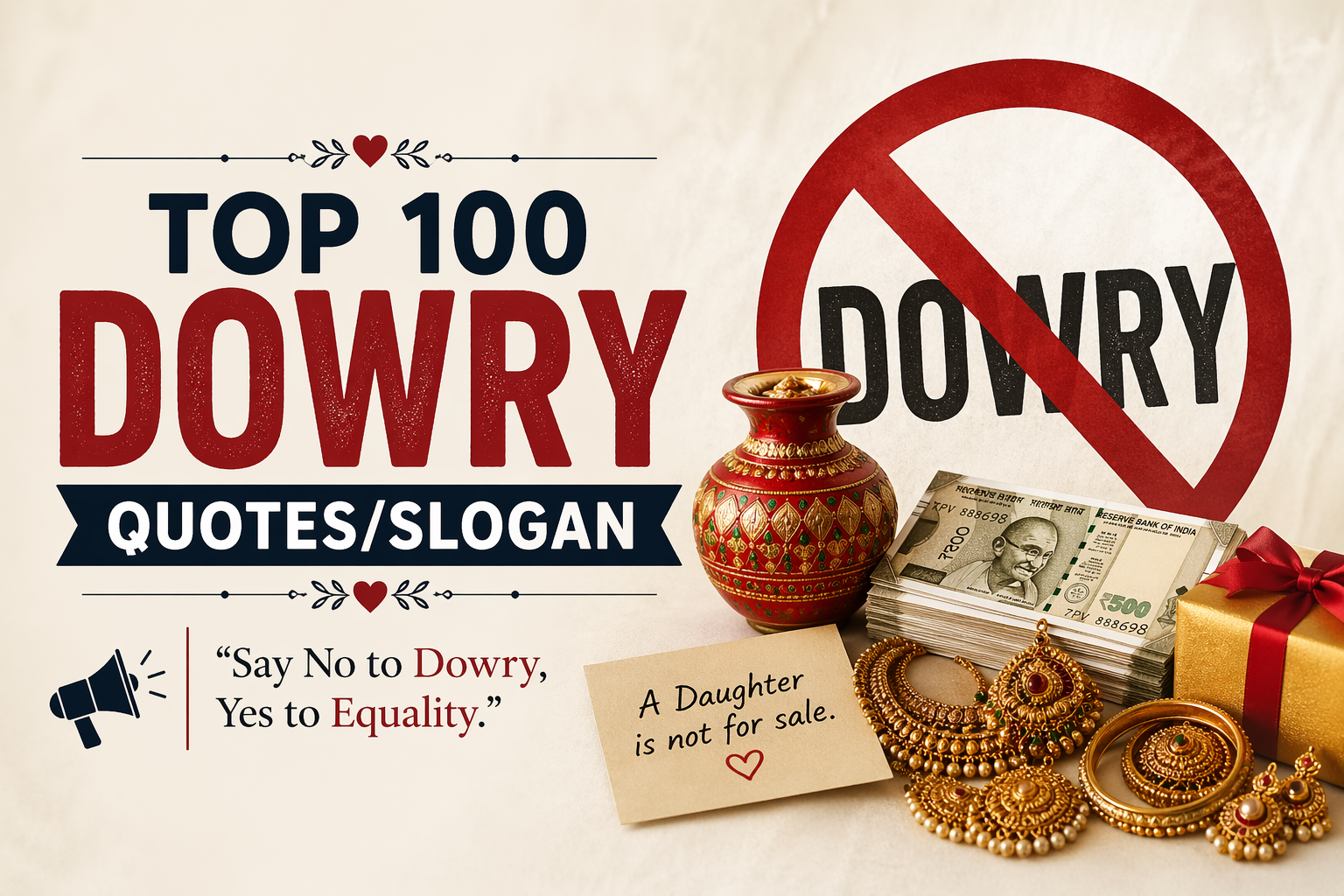
Dowry quotes and slogans are not mere rhetorical devices. They are semantic instruments of social change — compressed units of meaning that carry legal weight, cultural critique, emotional resonance, and behavioral intention simultaneously. When Mahatma Gandhi stated that any young man making dowry a condition to marriage discredits his education and dishonours womanhood, he was performing something linguistically extraordinary: collapsing a complex sociological argument into a single moral verdict.
In the context of India’s ongoing struggle against the dowry system — a practice that, according to NCRB data, results in over 6,100 deaths annually and more than 15,000 registered cases per year — the role of language in mobilizing conscience cannot be overstated. Slogans crystallize outrage. Quotes from public figures grant authority to dissent. Both serve as entry points for people who may not have access to legal texts but still need tools to articulate injustice.
This resource compiles 100 of the most powerful, meaningful, and campaign-ready dowry quotes and slogans, organized by theme and intent, alongside contextual analysis to help you use them effectively — whether in a poster, a speech, a seminar, or a social media campaign.
Related Reading: To understand the full legal landscape before crafting your message, read What Are The Possible Legal Implications of Dowry in India? and Dowry Deaths in India: Cases Rising or Falling?
The Semantic Architecture of an Anti-Dowry Slogan
Before presenting the 100 quotes and slogans, it is important to understand what makes a dowry slogan effective. Effective slogans operate across three semantic planes simultaneously:
1. The Cognitive Plane — the message must be understood instantly, even by someone with limited literacy. Short sentences, familiar words, and contrast (e.g., “love vs. dowry”) serve this function.
2. The Emotional Plane — shame, pride, fear, love, and dignity are the emotional levers. A slogan that triggers the right emotion in the right person can change behavior more reliably than a legal pamphlet.
3. The Social Plane — slogans function as public declarations. Repeating “Be a man, say NO to dowry” in a community setting transforms a private moral stance into a collective social norm.
This three-dimensional framework — cognitive clarity, emotional resonance, social mobilization — is what separates a forgettable tagline from a slogan that moves a generation.
Part 1: Famous Quotes on Dowry by Historical & Public Figures (1–15)
These quotations carry institutional weight. They are useful in academic papers, seminar introductions, legal briefs, and formal speeches.
1. “Any young man, who makes dowry a condition to marriage, discredits his education and his country and dishonours womanhood.” — Mahatma Gandhi
Context: Gandhi spoke these words during his campaigns for women’s rights and social reform in colonial India. Even a century later, this quote remains the single most cited reference in anti-dowry literature because it connects dowry demands directly to moral failure — not just personal, but national.
2. “As long as she is wise and good, a girl has sufficient dowry.” — Plautus (Roman Playwright, c. 254–184 BC)
Context: This ancient quote reveals that the equation of a woman’s worth with her character — rather than material exchange — is not a modern idea. It is useful to cite when arguing that the commodification of women through dowry is a cultural regression, not a cultural tradition worth preserving.
3. “The dowry system is a curse on Indian society.” — Supreme Court of India, Sanjay Kumar Jain v. State of Delhi (2011)
Context: The Supreme Court did not merely observe — it condemned. This judicial quotation is particularly powerful in legal-awareness campaigns and can be used to remind communities that the highest court in the land recognizes dowry as an institutionalized evil.
4. “Dowry is not a gift; it is a transaction that reduces a daughter to a commodity.” — Attributed to social reform discourse, widely used in Indian NGO literature
5. “Education of a girl is the best dowry a parent can give.” — Common wisdom, popularized in Beti Bachao Beti Padhao campaigns
Context: This quote functions as a semantic reframing — it does not argue against the word “dowry” but instead redefines what dowry should mean. A daughter’s education, employability, and independence become the true wealth she carries into marriage.
6. “The demand for dowry is the price of cowardice — a man’s admission that he cannot provide for himself.” — Paraphrase of grassroots anti-dowry reformer sentiment, Bihar (documented 2022)
7. “A bride is not a business transaction. Her value is not negotiable.” — Women’s rights discourse, South Asia
8. “When society treats daughters as financial burdens, it has already failed them before they are born.” — Social commentary, referenced in feminist literature on sex-selective practices
9. “Dowry deaths represent not just the failure of families, but the failure of a civilization.” — Academic discourse, Indian women’s studies scholarship
10. “No amount of gold can measure a woman’s worth. Those who demand it have no idea what wealth truly means.” — Contemporary social reform literature
11. “A man who demands dowry is selling his own dignity at the price of his bride’s family’s suffering.” — Feminist social commentary, widely circulated
12. “Dowry is a monster that devours daughters and feasts on a family’s dreams.” — Anti-dowry campaign literature, India
13. “The moment we stop demanding and start respecting, the dowry system will die its natural death.” — Indian social reform worker
14. “She brings herself — her mind, her heart, her future. That is more than enough.” — Progressive marriage reform discourse
15. “Real love does not come with a price tag attached to the bride’s family.” — Contemporary social awareness campaign
Part 2: Classic Anti-Dowry Slogans for Campaigns & Posters (16–40)
These slogans have been deployed in street campaigns, poster drives, seminars, and social media over the past decade. They are optimized for cognitive clarity and immediate emotional impact.
16. Take dowry, invite worry.
Analysis: The rhyme scheme makes this instantly memorable. The causal logic — demand equals consequence — creates a behavioral deterrent without requiring explanation.
17. Be a man. Say NO to dowry.
Analysis: This slogan uses masculine identity as leverage. It inverts the patriarchal script: rather than using gender to justify entitlement, it uses gender to demand responsibility.
18. Avoid dowry, marry for harmony.
19. Dowry greed leads to heinous deeds.
Analysis: The internal rhyme and stark moral judgment make this effective for public protests and banners.
20. Refuse dowry. Diffuse dowry deaths.
Analysis: The phonetic parallel between “refuse” and “diffuse” creates sonic urgency — the action and the outcome are linguistically linked.
21. Daughters are not commodities. End the dowry atrocity.
22. Love, not dowry, should be the price of a happy marriage.
23. Don’t search for a shareholder. Select a life-partner.
Analysis: This slogan uses economic language — “shareholder” — to expose how dowry transforms marriage from a human bond into a business deal.
24. Your better half gives a better deal in life. Don’t deal with dowry.
25. Shame on those who demand dowry.
26. Men who are cowardly depend on a girl’s dowry.
27. Don’t degrade yourself by demanding dowry.
28. Behave manly. Depend on your own earnings.
29. Ask for dowry and you invite your own destruction.
30. Condemn dowry deaths by not demanding dowry.
31. Several lives sacrificed for dowry. Stop this sacrilege.
32. Who chooses a wife based on dowry will have a painful life.
33. Real men earn it. They don’t beg for it.
34. Stop dowry. Start dignity.
35. Daughters are born — not to be sold, but to be celebrated.
36. Arrest the greed before it arrests a life.
37. Resist dowry demands or you will regret.
38. Do not be greedy. Stop dowry!
39. Say no to dowry. Say yes to equality.
40. An educated bride is far better than a billion in currency.
Part 3: Emotionally Powerful Slogans for Rallies & Public Events (41–60)
These slogans are designed for maximum emotional impact. They are appropriate for public rallies, awareness marches, school campaigns, and protest events.
41. Dowry divides. Love unites.
42. Real love doesn’t come with a price tag.
43. End dowry. Empower women.
44. She is your daughter. Not your debt.
Analysis: This slogan reframes the parent-child relationship. Daughters are framed not as financial liabilities but as human beings who have been wrongly monetized by patriarchal systems.
45. A bride is not a bargain. A bride is a blessing.
46. You raised a daughter. Not a transaction.
47. Her smile should cost you nothing. Her suffering should cost you everything.
48. Dowry kills dreams before it kills women.
49. Every dowry demand is a vote against your own dignity.
50. She walked into your home with hope. Don’t let dowry kill it.
51. Women are not for burning. Women are for honoring.
52. Her worth is not measured in gold. It’s measured in humanity.
53. Behind every dowry death is a demand that should have been refused.
54. Accept her with love. Not with a price list.
55. Stop the transaction. Start the transformation.
56. Dowry is not tradition. It is tyranny.
57. She came as your partner. Not as your purchase.
58. If you can’t stand on your own feet, you have no right to demand she bow at yours.
59. One dowry demand. One family destroyed. One life lost. Is it worth it?
60. Burn the dowry system. Not the bride.
Part 4: Slogans Addressing Legal Awareness (61–75)
These slogans combine behavioral messaging with legal awareness. They are appropriate for government campaigns, NGO literature, police awareness programs, and legal aid clinics.
Related Resource: Understand the full legal framework in our article on What Are The Possible Legal Implications of Dowry in India?
61. Dowry is illegal. Silence is complicity.
Context: The Dowry Prohibition Act of 1961 prohibits the giving, taking, or demanding of dowry. Section 80 of the Bharatiya Nyaya Sanhita (BNS) criminalizes dowry deaths with a minimum seven-year sentence. Citizens who witness dowry harassment and do nothing are enabling a crime.
62. Report dowry harassment. Protect a life.
63. Taking dowry: a fine of ₹5,000 or six months in jail. Is it really worth it?
64. Dowry death means life imprisonment. Choose love instead.
65. If you know of dowry cruelty and stay silent, you are part of the problem.
66. Don’t wait for a tragedy. Report dowry demands before they become dowry deaths.
67. Her courage to speak up deserves your courage to support her.
68. Section 498A exists. Use it. Her life may depend on it.
69. Awareness is the first law. The Dowry Prohibition Act is the second.
70. An NGO. A police station. A phone call. It could save her life.
71. Giving dowry is also a crime. Refuse both sides of the transaction.
72. The law protects her. Society must too.
73. Her marriage began with demands. Let your awareness end them.
74. Call out the dowry demand before it calls out a funeral.
75. Justice for dowry victims is not charity. It is constitutionally mandated equality.
Part 5: Slogans for Students, Youth & Schools (76–88)
Young people are the most powerful agents of cultural change. These slogans are appropriate for student campaigns, school debates, college awareness drives, and youth-led movements.
See Also: How To Prove Dowry Harassment? — an essential resource for young women and their allies.
76. Our generation says: love first, dowry never.
77. Educate your son. You’ll never need to educate him about dowry.
78. The future belongs to men who earn respect, not demand gold.
79. I promise never to give or take dowry.
80. Change begins in classrooms. Let’s talk about dowry.
81. Smart boys don’t need dowry. They need dignity.
82. Raise your son right and a daughter somewhere will live.
83. Don’t inherit your parents’ prejudice. Inherit their love.
84. Dowry is old thinking. Be the new generation.
85. A degree over a dowry — always.
86. Don’t marry for money. Earn it. Then marry for love.
87. If you’re educated enough to read this, you’re educated enough to refuse dowry.
88. The most powerful protest against dowry is choosing respect over greed.
Part 6: Hindi Slogans on Dowry (Dahej Ke Khilaf Nare) (89–100)
Hindi slogans carry particular resonance in states like Uttar Pradesh, Bihar, Madhya Pradesh, and Rajasthan — states that, according to NCRB data, account for a disproportionate share of India’s registered dowry death cases.
89. दहेज लेना और देना, दोनों हैं अपराध। (Taking and giving dowry — both are crimes.)
90. दहेज़ नारी का अपमान है। (Dowry is an insult to womanhood.)
91. दहेज कलंक है — मिटाओ इसे। (Dowry is a stain — erase it.)
92. बेटी कोई वस्तु नहीं जो दहेज से बिके। (A daughter is not a commodity to be sold through dowry.)
93. दहेज हटाओ, समाज बचाओ। (Remove dowry, save society.)
94. दहेज़ प्रथा एक अभिशाप है। (The dowry system is a curse.)
95. जब तक रहेगी दहेज प्रथा, बेटी रहेगी दुखी सदा। (As long as the dowry system persists, daughters will always suffer.)
96. दहेज माँगने वाला कायर होता है। (One who demands dowry is a coward.)
97. पाप से करो परहेज, मत माँगो शादी में दहेज। (Avoid sin, don’t demand dowry in marriage.)
98. दहेज़ प्रथा बंद करो, खुश रहकर आनंद करो। (End the dowry system, live happily and joyfully.)
99. दहेज नहीं, बेटी का सम्मान दो। (Don’t give dowry — give respect to daughters.)
100. बेटी बचाओ, दहेज हटाओ। (Save daughters, remove dowry.)
The Data Behind the Slogans: Why This Language War Matters
Slogans without context are decorative. To understand why this verbal mobilization is urgent, consider the following statistics:
- 6,100+ dowry-related deaths were reported in India in 2023, with over 15,000 total registered cases (Wikipedia / NCRB).
- Between 2017 and 2022, India averaged 7,000 dowry deaths annually, according to NCRB compiled data.
- An average of six dowry-related female suicides occur every day in India, according to forensic research published in Cureus journal (2024).
- 95% of marriages in rural India between 1960 and 2008 involved dowry transfers, per a World Bank study covering 40,000 marriages.
- Uttar Pradesh recorded the highest number of dowry death cases in 2022, with over 2,000 registered cases.
- States including West Bengal, Odisha, Bihar, Jharkhand, UP, MP, Rajasthan, and Haryana together accounted for 80% of all dowry death cases during the 2017–2022 period.
These are not abstract numbers. Each figure represents a woman who lived, hoped, and suffered — often in silence — because a language of resistance was not available to her family soon enough.
Explore Further: Dowry Deaths in India: Cases Rising or Falling? | Dowry Good or Bad? Pros, Cons & Legal Facts
How to Use These Quotes & Slogans Effectively
For Posters and Banners: Choose slogans that are five words or fewer, contain a rhyme or strong contrast, and use active verbs. Numbers 16, 17, 19, 20, and 30 are ideal for visual campaigns.
For Speeches and Seminars: Open with a famous quote (numbers 1–3), build your argument with contextual slogans, and close with an emotional call to action (numbers 44, 47, 60).
For Social Media: Short, contrast-based slogans perform best. Pair a slogan with a statistic for maximum engagement. Example: “Real love doesn’t come with a price tag” + “6,100 women died from dowry-related causes in India last year.”
For School Campaigns: Use student-targeted slogans (numbers 76–88), invite open discussion, and pair with a resource like How to Prove Dowry Harassment for the older student audience.
For Legal Aid Clinics: Lead with legal-awareness slogans (numbers 61–75) and pair with information on What Are The Legal Implications of Dowry in India?
The Semantics of Resistance: What Language Can and Cannot Do
It would be naïve to claim that slogans alone can dismantle the dowry system. As retired teacher Babu Mahesh Chandra of Bihar demonstrated — cycling through villages with anti-dowry banners day after day — the work is slow, relational, and requires physical presence alongside linguistic tools.
However, language does four things that physical presence alone cannot:
- It scales. A slogan printed on a banner is seen by thousands. Posted online, by millions.
- It persists. Long after a rally ends, a slogan on a wall continues to speak.
- It shifts the invisible. Cultural norms are maintained through repetition. Anti-dowry slogans insert competing repetitions into the same cultural space.
- It names the problem. Communities that lack the vocabulary to describe dowry harassment as a crime cannot report it as one. Language creates reportability.
This is why the 100 quotes and slogans in this article are not merely decorative. They are operational. They are tools — imperfect ones — in a larger battle for the dignity of daughters across South Asia.
Frequently Asked Questions
What is the most powerful anti-dowry slogan? By frequency of use and cultural impact, Mahatma Gandhi’s statement — that any young man who makes dowry a condition of marriage discredits his education and dishonours womanhood — remains the single most powerful quotation. Among shorter slogans, “Take dowry, invite worry” and “Be a man, say NO to dowry” are among the most widely deployed in campaign contexts.
When is Dowry Prohibition Day? Dowry Prohibition Day is observed on 26th November each year in India. It is dedicated to raising awareness about the social evil of dowry and the legal measures — including the Dowry Prohibition Act of 1961 — designed to combat it.
Is giving dowry also a crime in India? Yes. Under the Dowry Prohibition Act of 1961, both the giving and taking of dowry are criminal offenses, punishable by imprisonment of up to six months or a fine of up to ₹5,000, or both. For more detailed legal information, read What Are The Possible Legal Implications of Dowry in India?
Can I use these slogans for school or college projects? Absolutely. All slogans in this article are available for educational, awareness, and non-commercial use. Proper attribution to specific authors should be maintained where noted (e.g., Mahatma Gandhi’s quote).
What is the legal punishment for dowry death in India? Under Section 80 of the Bharatiya Nyaya Sanhita (BNS) 2023, a woman’s death by burns, bodily injury, or in suspicious circumstances within seven years of marriage, where she was subject to dowry-related cruelty, is classified as a dowry death. The minimum punishment is seven years imprisonment, extendable to life.
Conclusion: Words as Weapons Against an Ancient Wrong
The 100 dowry quotes and slogans compiled in this article represent far more than rhetorical material. They are the condensed voices of millions of women, reformers, jurists, and parents who refused to accept that a daughter’s life should be measured in gold and silver.
Whether you use these words on a protest banner, in a WhatsApp status, at a school assembly, or in a court filing, remember that language is never neutral. Every time someone says “Take dowry, invite worry” instead of staying silent, they are choosing a side. Every time a community repeats “Daughters are not commodities,” it makes that statement slightly more true.
The dowry system is not inevitable. It is maintained by silence and dismantled by exactly this kind of speech — precise, persistent, and public.
Explore the complete resource library on dowry, law, and reform at CalculateMyDahej.in/blog/
Research compiled from NCRB crime data, Supreme Court judgments, academic forensic literature (Cureus, 2024), World Bank marriage studies, and established anti-dowry campaign archives. All statistics current as of available NCRB records and referenced academic publications.
