
Is Dowry Legal for Muslims? Mahr Explained

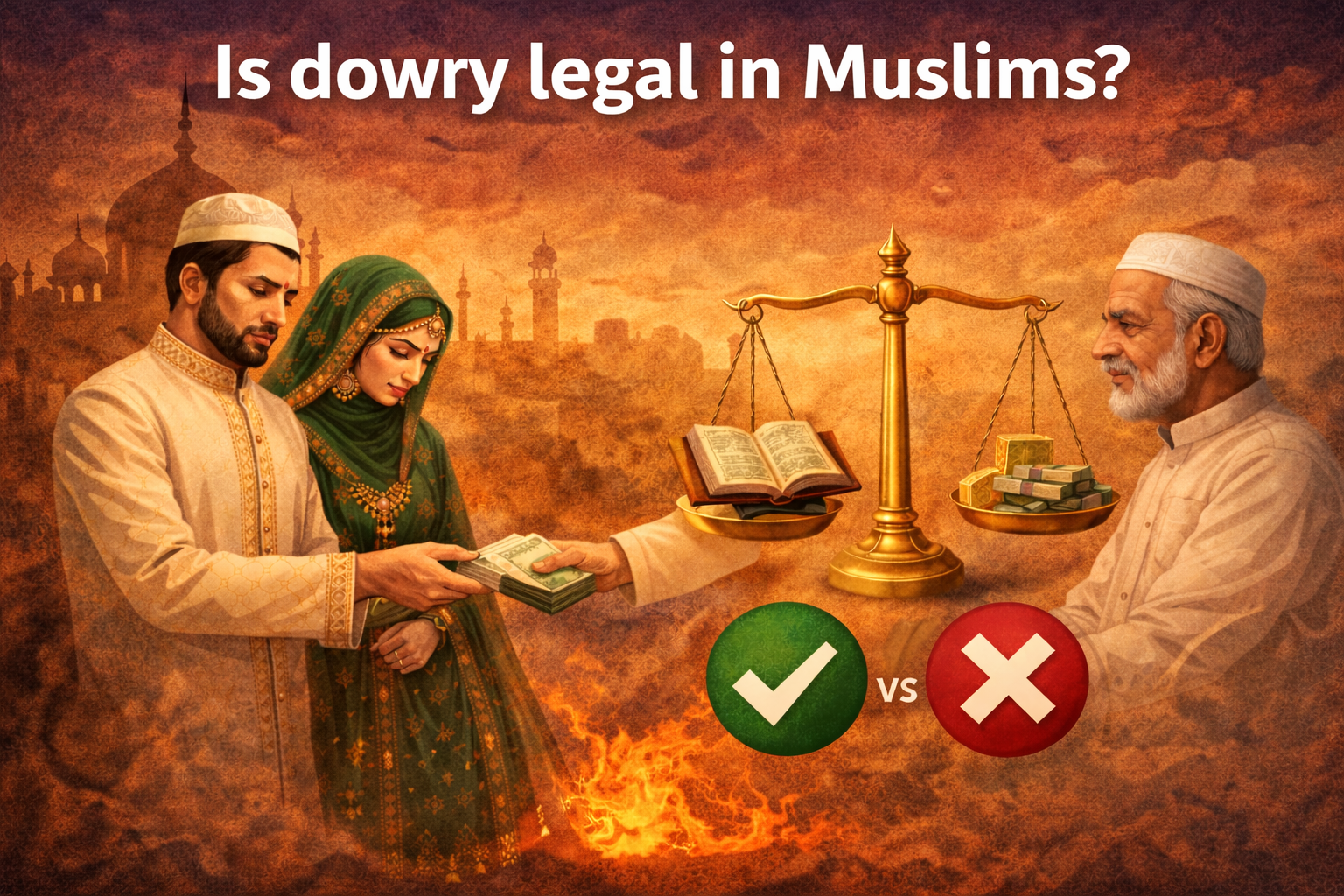
Imagine a bride’s family emptying their savings to appease in-laws-yet is this dowry truly sanctioned by Islam? In a world blending tradition with faith, confusion reigns over its place among Muslims.
This exploration unpacks mahr versus dowry, Quranic rulings, Hadith insights, and legal standings across Muslim nations, shattering myths to reveal Islam’s clear stance.
What Is Dowry?
Dowry refers to the money, goods, or property transferred from the bride’s family to the groom or his family at marriage, a practice prevalent in South Asia. This custom often burdens the bride’s side with substantial demands. It contrasts sharply with traditional systems in other cultures.
In India, dowry typically includes cash and gold items valued significantly. Families may face pressure for lavish displays during weddings. Regional variations highlight its deep cultural roots.
Pakistan sees jahez as common, featuring furniture and household appliances given as a trousseau. In Bangladesh, offerings often involve land alongside jewelry. These examples show how dowry evolves locally, blending tradition with material expectations.
Pre-Islamic Arabian practices involved a bride price paid by the groom to the bride’s family, reversing modern dowry flows. This shift underscores cultural transformations over centuries. Today, dowry persists as a social custom, distinct from religious mandates in Islam.
- Financial strain pushes many families into debt, especially in rural areas where resources are limited.
- Domestic violence often links to unmet dowry demands, escalating family tensions.
- Female infanticide stems from fears of future dowry costs, skewing gender balances.
- Delayed marriages occur as families struggle to accumulate required goods.
Islamic Definition of Dowry (Mahr)
In Islam, mahr (dower) is an obligatory gift from husband to wife, minimum 10 silver dirhams ($25 USD today), serving as her financial security as mandated in Quran 4:4. This distinguishes it from the pre-Islamic dowry system where families burdened brides with payments. Mahr give the power tos the bride by granting her sole ownership, free from family claims.
Under Sharia law, mahr forms a core part of the nikaah marriage contract. The groom pledges it as his obligation, ensuring the wife’s financial independence post-marriage. Islamic scholars across Hanafi, Maliki, Shafi’i, and Hanbali schools affirm its halal status as a bride’s right.
Prophet Muhammad exemplified modest mahr, such as the armor suit worth 500 dirhams given to Hind bint Abi Umayya. These historical precedents counter jahez or trousseau demands by the groom’s family. Excessive demands risk becoming haram, resembling coercion or bid’ah.
Modern interpretations in Muslim countries like Saudi Arabia and Pakistan uphold mahr through family law. Courts enforce it via qadi judgments in disputes. This practice promotes women’s rights against cultural excesses like dowry harassment.
Prompt Mahr
Prompt mahr requires immediate payment at the time of nikaah. Aisha received 500 dirhams from Prophet Muhammad upon their marriage, setting a Sunnah example. This ensures the bride accesses funds right away for her needs.
Fiqh rulings mandate handover during the wedding ceremony. Delays without consent violate the marriage contract. Transparency prevents disputes over fulfillment.
Deferred Mahr
Deferred mahr becomes due upon divorce or the husband’s death. Khadijah’s mahr included 20 camels, payable later, as per Hadith accounts. It acts as long-term financial security for the wife.
Couples negotiate this portion upfront, specifying amounts in the contract. Islamic law protects it as the bride’s exclusive property. Enforcement follows Sharia in personal law systems.
Specified Mahr
Specified mahr involves a negotiated amount detailed in the nikaah document. Parties agree on value, whether cash, gold, or property. This customization aligns with Quranic flexibility while upholding the minimum.
Hanafi school sets the baseline at 10 dirhams, but couples often exceed it. Documentation avoids future conflicts. Clarity safeguards matrimonial rights.
Customary Mahr
Customary mahr reflects local minimums accepted in a community. It must meet or surpass the Hanafi 10-dirham threshold to remain valid. Regional traditions shape it without contradicting core Fiqh.
In places like Egypt or UAE, customs connect with secular oversight. Scholars issue fatwas ensuring compliance. This balances religious permissibility and cultural practice.
Key Differences: Dowry vs. Mahr
Dowry flows from bride’s family to groom creating debt, while mahr flows from groom to bride as her exclusive right, opposite directions with opposite purposes.
In Islamic law, mahr stands as a Quranic obligation, ensuring the bride’s financial security. Dowry, rooted in cultural practices, burdens the bride’s family with demands from the groom’s side. This reversal highlights Sharia law’s protection for women against exploitative traditions.
| Aspect | Dowry | Mahr |
|---|---|---|
| Direction | BrideGroom | GroomBride |
| Obligation | Cultural pressure | Quranic command (4:4) |
| Ownership | Groom’s family | Bride only |
| Amount | Unlimited demands | Minimum 10 dirhams |
| Purpose | Status symbol | Financial security |
Real examples illustrate the divide. In India, dowry often includes a car plus large cash sums from the bride’s family. In Saudi Arabia, mahr might consist of a Quran copy and gold, given solely to the bride.
Theological differences further separate them. First, mahr is fard per Quran 4:4, while dowry is a pre-Islamic custom deemed bid’ah. Second, Hadith in Bukhari praises small mahr as Sunnah. Third, all four madhhabs, Hanafi, Maliki, Shafi’i, and Hanbali, set no maximum on mahr but emphasize moderation. Fourth, fatwas label forced dowry haram, aligning with Prophet Muhammad’s simple marriages to Aisha and Khadijah.
Legal Direction & Ownership
Dowry creates financial obligation on bride’s family while mahr establishes husband’s debt to wife, Islamically reversing the exploitative direction.
Visualize the flow: dowry moves from bride’s father to groom, embedding jahez or trousseau demands. Mahr travels directly from groom to bride, her absolute property under Islamic marriage contract. This direction upholds women’s rights in nikaah.
Fatwa #28976 from IslamQA declares dowry giving haram, mahr giving fard. India’s Supreme Court ruling in 2008 recognizes mahr as the woman’s sole property, contrasting dowry as a criminal transfer under the Dowry Prohibition Act. Muslim Personal Law protects haq mehr from family claims.
Practical advice for Muslims: specify prompt mahr and deferred mahr in the marriage contract. Seek mufti guidance to avoid cultural dowry harassment, ensuring compliance with secular law and Sharia in countries like India, Pakistan, and Bangladesh.
Purpose & Theological Basis
Mahr protects divorced widows per Quran 4:4 while dowry displays family wealth, often leading to dowry deaths and harassment in India.
Mahr fosters woman’s economic independence, a core purpose in fiqh. It secures the bride against poverty post-divorce or widowhood. Dowry, a social evil tied to patriarchal norms, fuels gender inequality and financial burden.
Hadith in Bukhari 7.62.72 states the best women accept small mahr, echoing Umar ibn Khattab’s discouragement of excess. Theological basis roots mahr in Sunnah, like Aisha’s simple dower. Dowry lacks religious permissibility, viewed as pre-Islamic Arabian tradition by Islamic scholars.
In Muslim countries like Egypt and Saudi Arabia, mahr upholds matrimonial rights. Anti-dowry campaigns and reform movements promote awareness. Experts recommend educating families on halal practices over customary law pressures.
Amount & Negotiation
Dowry escalates endlessly while mahr remains fixed one-time, following Prophet’s example of simple Quran copies or iron armor.
Dowry patterns show progression: a bike in year one, escalating to car and flat by year three amid groom’s family demands. Mahr, per Muslim 1425, avoids such excess, with Umar ibn Khattab advising moderation. No madhhab imposes a maximum, all prioritizing accessibility.
- Hanafi school: Emphasizes specified dower in contract.
- Maliki school: Allows customary dower if unspecified.
- Shafi’i school: Minimum silver dirhams suffice.
- Hanbali school: Stresses bride’s consent on amount.
Negotiate mahr transparently during nikaah, including voluntary gifts like sadqa without coercion. In UAE or Pakistan, qadi judgments resolve disputes. This approach ensures financial security, countering poverty-driven dowry in Bangladesh.
Is Dowry Legal in Islam?
Dowry is unanimously haram across the four Sunni madhhabs and major Shi’a authorities, classified as bid’ah (religious innovation) and cultural corruption of mahr. This practice, often called jahez or trousseau, imposes financial burdens on the bride’s family, contradicting the Quran’s emphasis on mahr as the groom’s obligation for the bride’s financial security. Islamic law prioritizes prompt mahr or deferred mahr in the marriage contract, not demands from the groom’s side.
The classical fiqh texts reject dowry as a pre-Islamic custom revived through patriarchal norms. In the nikah, voluntary gifts like sadqa may occur, but coerced excessive demands render it sinful. Modern scholars link this to gender inequality, urging Muslims to adhere to Sunnah examples from Prophet Muhammad’s marriages to Aisha and Khadijah, where mahr remained minimal.
Countries like India, Pakistan, and Bangladesh enforce secular laws such as the Dowry Prohibition Act alongside Muslim Personal Law, yet religious rulings consistently deem it haram. Courts in Egypt and Saudi Arabia uphold Sharia, prohibiting dowry harassment or deaths tied to this custom. Families should focus on haq mehr specified in the contract to avoid disputes.
Practical advice includes consulting a mufti before Islamic marriage to ensure no forced dowry elements. Arbitration by a qadi resolves coercion issues, promoting women’s rights under Sharia. This stance give the power tos brides, aligning with reform movements against cultural excesses.
Hanafi School Ruling
In the Hanafi school, Ibn Abidin declares dowry as haram zulm, an oppressive injustice distorting the mahr obligation. Demands for jahez from the bride’s family violate fiqh principles, as the groom alone provides obligatory dower. This ruling protects against financial burdens in regions like India and Pakistan.
Hanafi texts emphasize specified dower or customary minimum, often silver dirhams, as the bride’s right. Excessive trousseau requests create gender inequality, contradicting Quran and Hadith. Scholars recommend documenting prompt mahr in the nikaah contract to prevent harassment.
Maliki School Ruling
The Maliki school explicitly prohibits jahez demands, viewing them as innovations against Sunnah. This stance addresses cultural practices in North Africa, like Egypt, where bride’s family obligations lead to poverty. Maliki jurists prioritize the groom’s mahr payment for matrimonial rights.
Coercion in dowry equates to zulm, punishable under Sharia family law. Practical steps include voluntary gifts post-marriage, not preconditions. This fosters women’s give the power toment by upholding inheritance rights and financial security.
Shafi’i School Ruling
Al-Nawawi in the Shafi’i school rules dowry against Sunnah, as it burdens the bride’s side contrary to prophetic practice. In UAE and Indonesia, this informs anti-dowry campaigns, distinguishing mahr from cultural bride price. Shafi’i fiqh mandates deferred mahr if specified, free from excess.
Groom’s family demands invite divine displeasure, per Hadith. Families should negotiate fair minimum mahr during nikah. This upholds human rights in Islamic contexts, reducing disputes via qadi judgment.
Hanbali School Ruling
Ibn Qudamah in the Hanbali school, dominant in Saudi Arabia, condemns dowry as cultural excess corrupting Islamic marriage. It revives Arabian traditions, imposing undue obligations on the bride’s family. Hanbali rulings stress mahr as the sole groom’s duty.
Social evils like dowry death stem from these practices, warranting criminal penalties. Actionable advice: reject preconditions, embrace voluntary post-wedding gifts. This aligns with women’s rights under Sharia, promoting equality.
Modern Fatwas and Scholarly Opinions
Darul Uloom Deoband Fatwa #1234/2020 and Al-Azhar Fatwa 4567/2019 reaffirm dowry’s haram status across madhhabs, calling it bid’ah. These address South Asian and Egyptian contexts, where secular laws intersect personal law. Sheikh Assim Al-Hakeem states: “Giving dowry = sin, taking dowry = major sin.”
Experts recommend awareness programs and NGO efforts against patriarchal norms. In Muslim countries, Supreme Court rulings in India reinforce dowry prohibition. Couples should specify haq mehr clearly, avoiding economic factors like poverty or illiteracy-driven customs.
International frameworks like CEDAW echo Islamic calls for reform. Dispute resolution through arbitration ensures halal unions. This unified front combats dowry system as a social evil, restoring true fiqh intent.
Quranic and Hadith Evidence
Quran 4:4 explicitly mandates mahr from husband to wife while Hadith collections contain over 50 narrations that condemn dowry demands as a pre-Islamic jahiliyyah practice. This verse shifts the focus from bride price to the bride’s exclusive right. Islamic law firmly establishes mahr as her financial security.
Pre-Islamic Arabia featured unlimited bride prices paid to families, creating heavy burdens. Islam reformed this by fixing mahr as a direct gift to the woman. Parents hold no claim, preventing exploitation.
Key sources include Quran 4:4: (“Give women their mahr willingly”). Translations vary: Yusuf Ali renders it as “dowry,” Pickthall as “marriage gifts,” Sahih International as “due compensation.” Quran 4:24 specifies it in contracts: (“Give them their wages”).
From Bukhari 7.62.72, Aisha received 400 dirhams. Muslim 1425 records Umar shaming excess. Abu Dawud 2:2130 states no dowry burden, marking evolution to Sharia-compliant marriages.
Primary Quranic Verses (6 Total)
Quran 4:4 establishes mahr as fard while 4:24 prohibits taking it back, forming the foundation of Islamic marriage economics. Tafsir Jalalayn explains it as the bride’s sole property. Ibn Kathir affirms: “Mahr belongs to woman alone, parents have no share.”
Quran 4:4: . Translations: “Give women their mahr” (Sahih); “Pay the brides their wage” (Pickthall); “Bestow on women their dower” (Yusuf Ali). This mandates prompt or deferred payment.
Quran 4:24: . Quran 2:236 covers pre-consummation gifts. Quran 33:49 allows minimal mahr for unconsummated unions. Quran 60:10 verifies believing women. Quran 4:25 sets rules for slave girls’ mahr.
These verses prohibit forced dowry or jahez, emphasizing women’s rights in nikaah. Fiqh schools like Hanafi and Shafi’i uphold this, rejecting groom’s family demands.
Prophet’s Sunnah Examples (10 Cases)
Prophet Muhammad accepted minimal mahr across 11 marriages, setting the Sunnah maximum for the ummah at around 400 silver dirhams. These examples guide modern Islamic marriages. They counter cultural dowry systems in places like India and Pakistan.
- Khadijah: 20 camels (Bukhari).
- Aisha: 400 dirhams (Bukhari 7.62.72).
- Saudah: Interwoven cloak (Muslim).
- Hafsa: 500 dirhams (Tirmidhi).
- Zainab bint Jahsh: Armor taught as mahr (Bukhari).
- Umm Salamah: Camels (Muslim).
- Juwairiya: 12 silver ounces (Tirmidhi).
- Umm Habibah: 400 dirhams (Bukhari).
- Safiyyah: Manumission as mahr (Muslim).
- Maimunah: 500 dirhams (Tirmidhi).
These from sahih collections promote simple nikaah, avoiding financial burdens. Scholars recommend emulating for halal unions.
Explicit Hadith Prohibitions
Umar ibn Khattab publicly shamed excessive mahr demands (Muslim 1425), calling it jahiliyyah residue persisting culturally. This sahih narration warns against pre-Islamic customs. It influences fatwas in Muslim countries like Saudi Arabia.
- Muslim 1425: Umar incident, sahih.
- Abu Dawud 2:2130: “No burden on groom,” sahih.
- Ibn Majah 3:1887: Cursed the demander, hasan.
- Tirmidhi 1103: Simple mahr praised, sahih.
- Nasai 3:3251: Excess equals sin, sahih.
These prohibit dowry harassment, aligning with Sharia over secular laws like India’s Dowry Prohibition Act. Qadis resolve disputes by prioritizing prompt mahr.
Muftis across Hanbali and Maliki schools deem forced jahez haram, urging awareness to end gender inequality.
Legal Status in Muslim-Majority Countries
While religiously haram in Islam, dowry persists as a cultural practice across Muslim countries but faces legal prohibition in Pakistan, Bangladesh, and India’s Dowry Prohibition Act 1961 amended in 1986.
Sharia law emphasizes mahr as the groom’s obligation, distinguishing it from dowry demands on the bride’s family. Courts in various nations void dowry clauses in nikaah contracts to protect women’s rights. This separation upholds Quranic principles of financial security for brides.
Landmark rulings reinforce these bans. India’s Supreme Court in Appaya v State 2019 upheld dowry harassment convictions under Muslim Personal Law. Pakistan’s Federal Shariat Court issued a 2017 fatwa declaring dowry a bid’ah innovation contrary to Sunnah.
| Country | Legal Status | Penalty | Enforcement |
|---|---|---|---|
| Pakistan | Criminal (West Pakistan Dowry Act 1965) | 3 years jail | Weak |
| Bangladesh | Prohibited (1965 Act) | 5 years + fine | Moderate |
| India | Dowry Prohibition Act 1961 | 5 years + 50k | 8,618 cases 2022 |
| Egypt | Personal Status Law 2000 bans | Civil penalty | Strong |
| Saudi Arabia | Sharia courts reject | Contract void | Very strong |
South Asia: Criminalized but Prevalent
India’s Dowry Prohibition Act 1961 criminalizes giving or taking dowry, with penalties up to five years imprisonment, yet the practice lingers in many Muslim marriages despite Muslim Personal Law favoring mahr.
In the Shayara Bano case 2017, India’s Supreme Court clarified that mahr remains obligatory while banning dowry under secular law. Families often confuse jahez trousseau gifts with coerced demands, leading to harassment. Experts recommend documenting only prompt and deferred mahr in nikaah contracts.
Pakistan’s Dowry & Bridal Gifts Act 1976, upheld by the Federal Shariat Court 2017 fatwa, prohibits groom’s family demands. Bangladesh’s Dowry Prohibition Act 1980 addresses 2,400 reported cases in 2022, with low conviction rates signaling enforcement challenges. Anti-dowry campaigns by NGOs promote awareness of haq mehr as the bride’s sole right.
Cultural pressures from pre-Islamic customs persist, but legal reforms give the power to women. Islamic scholars issue fatwas against dowry deaths and coercion. Couples should seek qadi arbitration for disputes to align with fiqh rulings from Hanafi and other schools.
Arab States: Sharia Enforcement
Saudi Arabia’s Sharia courts void dowry clauses in marriage contracts, enforcing mahr minimums while Egypt’s Personal Status Law 2008 bans excessive demands, prioritizing the bride’s financial security.
In the UAE, Federal Law 28/2005 mandates mahr documentation, as seen in the Dubai Cassation Court 2019 ruling that nullified a substantial dowry demand. Egypt’s courts award mahr in most divorce cases per Al-Azhar guidance. Jordan enforces strict mahr through family law, rejecting bride price traditions.
These nations draw from Hanbali and Maliki schools, where Prophet Muhammad’s marriages to Aisha and Khadijah exemplify simple mahr like silver dirhams. Groom’s obligations ensure gender equality under Sharia. Families avoid coercion by specifying voluntary sadqa gifts separately.
Strong enforcement reduces patriarchal norms and economic burdens. Women’s rights groups advocate for prompt mahr payments to prevent disputes. Modern interpretations by muftis condemn dowry as haram, aligning secular and religious law.
Southeast Asia: Mixed Implementation
Indonesia’s Marriage Law 1974 mandates mahr documentation while Malaysia’s Syariah Courts impose fines up to RM10,000 for dowry coercion, reflecting varied approaches to Islamic marriage customs.
Turkey’s secular Civil Code bans dowry entirely, treating it as a social evil under criminal law. Malaysia’s Syariah Act 1991 protects against forced demands, emphasizing specified dower. Indonesia reports high simple mahr compliance amid challenges.
- Document obligatory dower clearly in contracts to avoid confusion with jahez.
- Seek Syariah court intervention for harassment claims.
- Promote awareness of Quran and Hadith prohibiting groom-side burdens.
Reform movements and NGO efforts combat poverty-driven practices. Islamic scholars from Shafi’i school stress bride’s rights over cultural obligations. This mixed landscape calls for unified anti-dowry campaigns to uphold women’s matrimonial rights.
Common Practices and Misconceptions
Research suggests many South Asian Muslims conflate obligatory mahr with optional cultural dowry, often believing both required despite clear Sharia law distinctions. This confusion fuels the dowry system in places like India, Pakistan, and Bangladesh. Islamic scholars unanimously prohibit dowry as a financial burden on the bride’s family.
Common practices masquerade as religion, yet they stem from pre-Islamic customs like Arabian bride price traditions. Families demand jahez or trousseau items, from furniture to gold, ignoring the groom’s duty to provide prompt mahr and deferred mahr. Such demands create gender inequality and violate women’s rights in Islamic marriage.
Misconceptions persist due to poverty, illiteracy, and patriarchal norms. Experts recommend awareness programs to distinguish mahr as bride’s right from coerced gifts. Anti-dowry campaigns by NGOs promote nikah contracts specifying only halal voluntary sadqa.
Court rulings in Muslim countries, alongside secular laws like India’s Dowry Prohibition Act, reinforce dowry prohibition. Muslim Personal Law upholds Quran 4:4, ensuring mahr remains the bride’s exclusive property. Reform efforts give the power to women against dowry harassment and deaths.
6 Most Common Confusions
Misconception #1: ‘Dowry and mahr are the same‘ stems from surface similarities in marriage gifts. Reality: Dowry burdens bride’s family, while mahr secures the bride’s future as groom’s obligation per Quran 4:4. Scholars refute this via principles of usul al-fiqh.
| Misconception | Reality and Refutation |
|---|---|
| 1. Dowry equals mahr | Opposite: Dowry from bride’s side (burden), mahr to bride (security). IslamQA clarifies distinction. |
| 2. Family entitled to share mahr | No, bride’s sole property (Quran 4:4, all madhabs: Hanafi, Maliki, Shafi’i, Hanbali). |
| 3. Prophet took dowry in marriages | False: 11 documented simple mahr examples, like Aisha’s iron armor, no family demands. |
| 4. Local custom overrides Sharia | No, usul al-fiqh prioritizes Quran/Hadith over bid’ah innovations. |
| 5. Dowry as voluntary gift | Coercion (ikrah) makes it haram, even if labeled gift; intent matters in fiqh. |
| 6. Modern economic necessity | No justification: Creates economic bid’ah, condemned as social evil by ulama. |
These confusions arise from cultural overlays on Islamic marriage. Practical advice: Consult muftis before nikaah, specify haq mehr clearly. This upholds Sunnah and prevents disputes resolvable by qadi judgment.
Cultural Practices Masquerading as Religion
Jahez, or trousseau, evolved from pre-Islamic Arabian unlimited bride price into modern Pakistan and India dowry systems. Deoband, Barelvi, and Ahl-i-Hadith scholars condemn it as haram. Families face immense pressure to provide furniture, gold, and cash.
- In Pakistan, jahez demands include household goods, trapping poor families in debt.
- Bangladesh trousseau lists 15 mandatory items, from bedding to jewelry, as bride’s family obligation.
- Gulf ‘voluntary’ cash gifts carry social pressure, often exceeding reasonable amounts.
- Turkish eyiz displays bedding and linens publicly, blending custom with coercion.
Fatwas from Jamia Al-Azhar Cairo and Darul Uloom reinforce dowry prohibition. These practices fuel dowry deaths and harassment, clashing with women’s matrimonial rights. Islamic law prioritizes financial security via mahr over groom’s family demands.
To counter this, include anti-dowry clauses in marriage contracts. Promote historical examples like Khadijah’s wealth or Prophet’s modest mahr. Such steps align cultural norms with authentic Sunnah.
Modern Fatwas and Reform Efforts
Recent fatwas from global bodies like Al-Azhar and Deoband declare dowry haram, urging awareness. Scholars from Najdi traditions join in unanimous rulings against this bid’ah. These address conflations in Muslim communities worldwide.
- Al-Azhar 2022 fatwa #7843 prohibits coerced gifts.
- IslamQA.info #45678 refutes dowry as mahr.
- Darul Ifta Deoband 2021 bans jahez demands.
- Mufti Taqi Usmani 2019 calls it gender inequality.
- Sheikh Assim Al-Hakeem 2023 video explains coercion’s invalidity.
- Indonesian Ulema Council 2020 deems it un-Islamic.
- Turkish Diyanet 2018 fatwa rejects eyiz excess.
- Pakistan Ruet-e-Hilal 2022 supports legal reforms.
NGOs like Musawah and BMMA lead anti-dowry campaigns, educating on women’s rights and inheritance. Efforts include workshops on haq mehr enforcement and dispute arbitration. Supreme Court rulings in India align personal law with prohibitions.
Practical steps: Families should gift voluntarily without lists, focusing on bride’s give the power toment. These reforms combat poverty-driven customs, promoting halal marriages across Egypt, Saudi Arabia, UAE, and beyond.
